Finding out your vehicle is a total loss after a car accident is stressful enough on its own. Finding out that your insurance payout does not cover what you still owe on your car loan or lease makes an already difficult situation significantly worse. This is the gap that GAP insurance exists to address, and for Georgia drivers with financed or leased vehicles, understanding how it works before you need it, or immediately after a total loss, can be the difference between walking away clean and carrying thousands of dollars in debt on a car you can no longer drive. At Hall and Collins Accident and Injury Lawyers, we work with Athens-area accident victims navigating the financial aftermath of serious crashes, and GAP insurance questions come up more often than most people expect.
This blog is for informational purposes only and does not constitute legal advice. If you have questions about your specific situation after a Georgia car accident, contact our office for a free consultation.
What GAP Insurance Is and Why It Exists
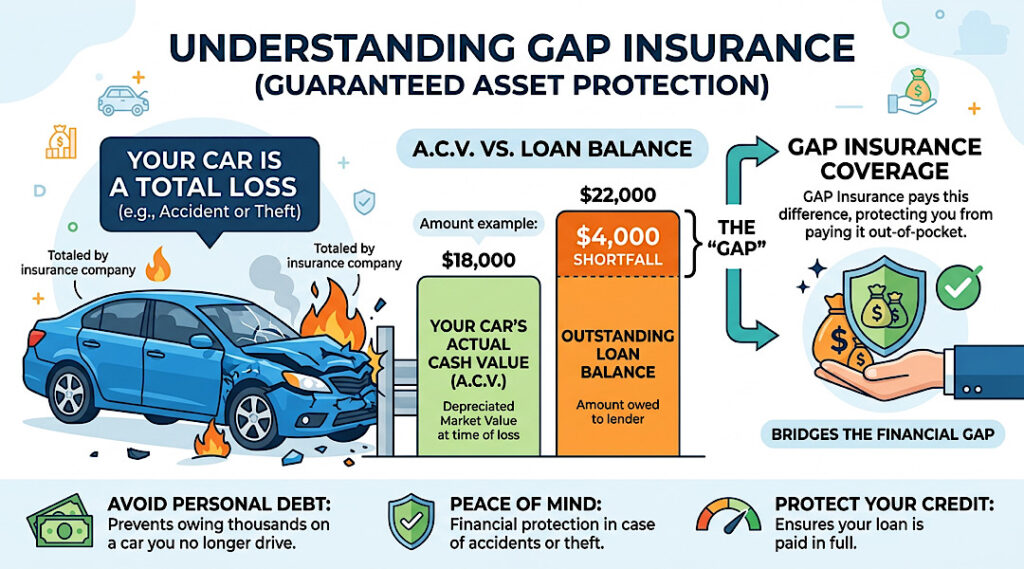
GAP stands for Guaranteed Asset Protection. It is a type of supplemental coverage designed to cover the difference between what your primary auto insurance pays out after a total loss and what you actually owe on your vehicle loan or lease at the time of the accident.
Here is why that gap exists in the first place. When you finance or lease a vehicle, you owe the lender the full loan or lease balance regardless of what happens to the vehicle. Your primary auto insurance, on the other hand, pays the actual cash value of the vehicle at the time of the loss, which reflects depreciation. A new vehicle can lose fifteen to twenty percent of its value in the first year alone. If you financed with a small down payment or rolled negative equity from a previous vehicle into your new loan, the difference between what the vehicle is worth and what you owe can be substantial from the moment you drive off the lot.
After a total loss accident, your primary insurer pays you the actual cash value of your totaled vehicle, not the amount you paid for it and not the amount you owe on it. If that payout is less than your remaining loan balance, you are responsible for covering the difference out of pocket unless you have GAP coverage. Understanding how Georgia car accident settlements work provides useful context on how insurance payouts are calculated after a Georgia crash.
When GAP Insurance Applies After a Georgia Total Loss
GAP insurance only applies in specific circumstances, and knowing whether your situation qualifies is the first thing to sort out after a total loss.
The Vehicle Must Be Declared a Total Loss
GAP coverage applies only when the vehicle is declared a total loss, meaning the cost to repair the vehicle exceeds its actual cash value or a defined percentage of it, depending on the insurer's guidelines. If your vehicle is damaged but repairable, GAP insurance does not come into play. Georgia uses a total loss threshold approach where a vehicle is typically considered a total loss when repair costs reach or exceed seventy-five percent of the vehicle's actual cash value.
You Must Owe More Than the Vehicle Is Worth
For GAP coverage to pay anything, your loan or lease balance must exceed the actual cash value payout from your primary insurer. If your primary insurer's payout covers your full loan balance, GAP coverage has nothing to contribute. The benefit only activates when there is a genuine shortfall between what your insurer pays and what you owe.
Your Primary Insurance Claim Must Be Settled First
GAP insurance pays after your primary auto insurance settles the total loss claim. The GAP coverage bridges the remaining difference. This means the accuracy and fairness of your primary insurer's actual cash value determination directly affects how much GAP coverage needs to contribute. If your primary insurer undervalues your vehicle, your GAP coverage covers a larger portion of the shortfall, but you may have grounds to dispute the actual cash value calculation before accepting the settlement. Why you should never accept the first insurance offer in Athens explains why the first offer is often not the final or fair one.
Where GAP Insurance Comes From and How to Find Yours
GAP insurance can come from several sources, and knowing where yours is, or whether you have it at all, is an important early step after a total loss.
Dealer-Purchased GAP Coverage
Many car dealerships offer GAP insurance at the time of purchase, often rolling the cost into the vehicle financing. If you purchased GAP coverage through the dealership, the policy information should be in your financing paperwork. Contact the dealership's finance department if you are unsure whether GAP was included in your purchase.
Lender-Provided GAP Coverage
Some auto lenders include GAP coverage as a standard feature of their loan products, particularly credit unions. Check your loan agreement or contact your lender directly to confirm whether GAP coverage is included and what the claim process looks like.
Insurer-Provided GAP Coverage
Some auto insurance carriers offer GAP coverage as an add-on endorsement to a standard auto policy. If you purchased GAP through your insurer, it will appear as a separate coverage on your declarations page. Your insurance agent can confirm whether this coverage is on your policy.
How to File a GAP Insurance Claim in Georgia
The GAP claim process begins after your primary auto insurance total loss claim is settled. Here is what the process generally looks like.
First, obtain your primary insurance settlement documentation, including the actual cash value determination, the settlement amount, and written confirmation that the vehicle has been declared a total loss. Second, contact your GAP provider with that documentation and request their claim forms. Third, obtain a payoff statement from your lender showing the exact remaining balance on your loan or lease as of the date of the loss. The difference between the primary insurer's payout and the payoff balance is what GAP covers, subject to the terms of your specific GAP policy.
Be aware that GAP policies typically have exclusions. Common exclusions include overdue loan payments carried into the balance, extended warranties or service contracts financed into the loan, credit life or disability insurance premiums added to the loan, and in some cases negative equity rolled over from a previous vehicle. Reading your GAP policy terms carefully before assuming full coverage of the shortfall prevents unpleasant surprises during the claim process.
What Happens to Your Loan If You Do Not Have GAP Insurance
If your vehicle is totaled and you do not have GAP coverage, you are responsible for paying the remaining loan balance after the primary insurance payout is applied. This means you may be making payments on a vehicle you no longer have while also needing to finance a replacement vehicle. For many Georgia drivers, this is a significant financial hardship that takes months or years to resolve.
If you were not at fault for the accident, the at-fault driver's liability insurance may cover your vehicle's actual cash value as part of your property damage claim. However, liability coverage from the at-fault driver pays the value of the vehicle, not your loan balance, just like your own collision coverage would. The shortfall problem exists regardless of fault unless you have GAP coverage or pursue additional legal remedies. Who pays medical bills after a car accident in Georgia covers the broader question of financial responsibility after a Georgia crash.
Diminished Value and Total Loss: Understanding Your Full Recovery Options
If your vehicle is not totaled but is repaired after an accident, Georgia law recognizes that a vehicle with an accident history is worth less than an equivalent vehicle with a clean history even after professional repairs. This loss in market value is called diminished value, and Georgia drivers have the right to pursue a diminished value claim against the at-fault driver's insurer in addition to repair costs.
For vehicles that are totaled, the diminished value concept is replaced by the actual cash value determination, which is where disputes most commonly arise. If you believe your insurer's actual cash value determination undervalues your vehicle, you have the right to dispute it by providing comparable vehicle listings, independent appraisals, and documentation of your vehicle's condition and features. The diminished value claim process in Georgia and how Athens drivers can recover more after a wreck covers this process in detail.
When the At-Fault Driver's Insurance Is Involved
If another driver caused the accident that totaled your vehicle, their liability insurance is responsible for your property damage up to their policy limits. This includes the actual cash value of your totaled vehicle. However, the at-fault driver's insurer has the same obligation as your own insurer, paying the actual cash value of the vehicle rather than your loan balance.
If the at-fault driver is uninsured or underinsured, your own uninsured motorist property damage coverage, if you have it, may apply to your vehicle loss. Georgia law requires insurers to offer uninsured motorist coverage, though drivers can reject it in writing. If you have UM coverage, it can help bridge the gap when the at-fault driver cannot pay.
When a serious injury accompanies the total loss, the personal injury side of your claim is separate from the property damage claim and may involve significantly larger compensation for medical expenses, lost income, pain and suffering, and other damages. The Athens car accident lawyer page at Hall and Collins explains how the firm approaches both the property and injury sides of a Georgia accident claim.
Practical Steps for Athens Drivers After a Total Loss
If your vehicle has been declared a total loss after a Georgia accident, here is what to do to protect your financial position.
Locate your GAP policy documentation immediately. Do not wait until after the primary insurance claim settles to find out whether you have GAP coverage and what it covers. Contact your lender and request a payoff statement as of the date of loss. Do not accept the primary insurer's actual cash value determination without reviewing it against comparable vehicle listings in your area. If the valuation seems low, dispute it in writing before accepting the settlement. Review your GAP policy exclusions carefully so you know exactly what the coverage will and will not pay. And if the accident involved injuries as well as a total loss, do not settle the property damage claim in a way that affects your ability to pursue the full value of your injury claim.
The step-by-step guide to what to do after a car accident in Athens covers the full sequence of actions that protect both your health and your claim after a Georgia crash.
Frequently Asked Questions About GAP Insurance and Total Loss in Georgia
Does GAP insurance cover the full amount I owe on my car loan after a total loss?
GAP insurance covers the difference between your primary insurer's actual cash value payout and your remaining loan or lease balance, subject to policy exclusions. It does not cover overdue payments, amounts added to the loan for service contracts or insurance products, or in some policies, negative equity rolled in from a previous vehicle. Review your specific GAP policy terms to understand exactly what is and is not covered.
What if the at-fault driver's insurance is paying for my totaled vehicle? Do I still need GAP?
The at-fault driver's liability insurance pays the actual cash value of your totaled vehicle, not your loan balance. If that payout is less than what you owe, you have the same shortfall problem regardless of whose insurance is paying. GAP coverage applies in this situation as well, bridging the difference between whatever the at-fault insurer pays and your remaining loan balance.
Can I dispute the actual cash value determination my insurer gives me?
Yes. You have the right to dispute your insurer's actual cash value determination by providing documentation of comparable vehicles listed for sale in your area, independent appraisals, and documentation of your vehicle's condition, features, and recent maintenance. Insurers use valuation tools that do not always reflect local market conditions accurately, and disputing a low valuation before accepting a settlement can meaningfully increase the payout.
How long do I have to file a GAP insurance claim in Georgia?
GAP policy terms vary, but most require you to file within a defined period after the primary insurance total loss settlement. Review your GAP policy for the specific filing deadline and begin the process as soon as your primary claim settles, rather than waiting. Missing the GAP filing deadline can result in forfeiture of coverage.
If I was injured in the accident that totaled my car, should I settle the property damage claim first?
Settling your property damage claim separately from your injury claim is generally acceptable, but you should be careful not to sign any documents that release the at-fault party from liability beyond property damage. If you have questions about how accepting a property settlement might affect your injury claim, speaking with an attorney before signing anything is the right step.
Where can I get help with my total loss claim or car accident injury claim in Athens?
Hall and Collins Accident and Injury Lawyers works with Athens-area accident victims on both the property damage and injury sides of Georgia car accident claims. Contact our office for a free consultation to discuss your situation and understand your options.
Talk to an Athens Car Accident Lawyer About Your Total Loss Situation
A total loss after a Georgia car accident creates financial pressure that arrives at exactly the wrong time. Understanding your GAP coverage, disputing an undervalued actual cash value determination, and protecting your injury claim while navigating the property damage process are all areas where having the right information and the right legal support makes a real difference. Hall and Collins Accident and Injury Lawyers serve Athens and the surrounding area with the kind of direct, practical guidance that helps accident victims make informed decisions when it matters most. Call (706) 351-6055 or contact us online for a free consultation.
This blog is for informational purposes only and does not constitute legal advice. Every case is different. Contact Hall and Collins Accident and Injury Lawyers to discuss the specific facts of your situation.
